Most chemical accidents on farms and at dealer premises are not caused by exotic failures. They come from ordinary situations: a product decanted into a drink bottle, a leaking container on a shelf above a food sack, a spray mixed without gloves, or an empty drum reused for water.
This checklist covers the full handling chain — storage, transport, mixing, application, cleaning and disposal — with the precautions that apply in a hot climate where summer store temperatures can be extreme. The product label and safety data sheet remain the authority in every case.
Keep every product in its original, labelled container
The original container carries the product name, the active ingredient, the formulation, the batch number, hazard symbols, the approved uses, the dose and the first-aid instructions. Once a product leaves that container, all of that is lost.
Decanting into drink bottles or unmarked cans is the single most dangerous habit in chemical handling, because the container then looks like something safe to drink. This risk falls hardest on children and on anyone who was not present when the transfer happened.
If a label is damaged or unreadable, do not guess from colour, smell or memory. Request a replacement label or the safety data sheet from the supplier and keep the product isolated until the identity is confirmed.
Set up the store correctly
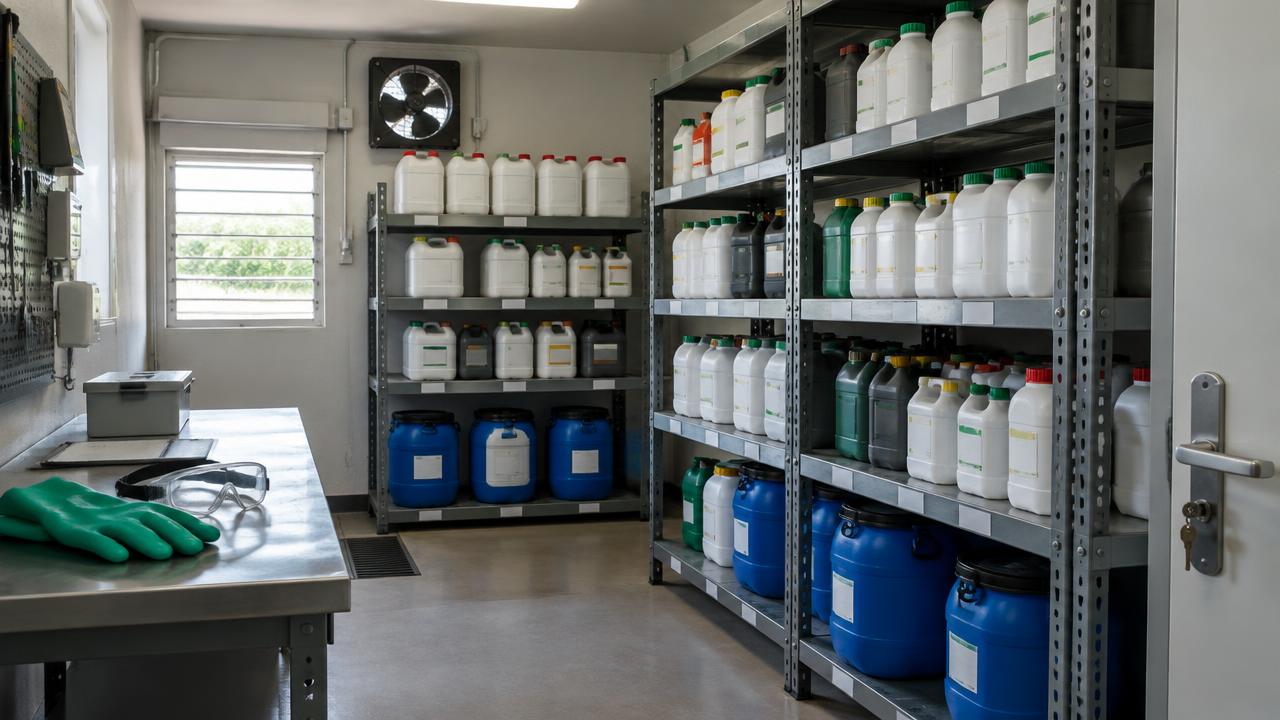
A chemical store should be a defined, lockable space used only for that purpose, away from living areas, kitchens, drinking water sources, animal feed and seed. Access should be limited to people who have been shown how to handle what is inside.
Ventilation matters, especially in summer. Vapour builds up in a closed room, and heat can degrade some formulations or raise pressure inside containers. Shade, cross-ventilation and shelving away from direct sun all help. Labels frequently state a storage temperature range, and that range is the guide.
Store containers on shelves rather than directly on the floor, with liquids below powders so that a leak cannot contaminate a powder below it. Keep herbicides physically separate from other products to reduce the chance of cross-contamination. Provide a bund, tray or sand tray to catch spills, and keep an absorbent material such as dry sand available.
- Locked, dedicated, well-ventilated room or cabinet.
- Away from food, feed, seed, water sources and living quarters.
- Shelved, with liquids stored below powders.
- Herbicides stored separately from other categories.
- Spill kit, dry sand, and a clearly visible warning sign on the door.
- Stock list with product names, quantities and purchase dates.
Wear the protection the label specifies
The label and safety data sheet name the protective equipment required for that product: chemical-resistant gloves, eye protection, a suitable mask or respirator, long sleeves, trousers and closed footwear. That list is the minimum, not a suggestion.
Cloth or household gloves absorb concentrate rather than blocking it, and a cotton scarf across the face is not a respirator. Nitrile gloves, goggles and the mask type named on the label are the correct choices, and they should be washed or replaced according to the instructions.
Never eat, drink or smoke while handling chemicals. Wash hands, face and any exposed skin immediately after handling, and wash contaminated clothing separately from household laundry.
Mix and apply with care
Mixing is the point of highest exposure, because you are working with undiluted concentrate. Mix outdoors or in a well-ventilated place, standing upwind, using a dedicated measuring jug that is never used for anything else. Add the product to water, not water to the product, unless the label directs otherwise, and keep the container closed when not pouring.
Mix only the amount needed for the area being treated. Leftover spray solution is a disposal problem with no good answer, and it tempts people to over-apply the remainder.
During application, watch wind and temperature. Spraying in strong wind causes drift onto neighbouring crops, houses and water channels; spraying in the hottest part of the day increases evaporation and operator exposure. Early morning and late afternoon are generally more suitable. Keep people and animals out of the treated area for the re-entry interval stated on the label, and respect the pre-harvest interval before harvesting.
Transport, spills and first aid
In transport, containers should be secured upright so they cannot tip or be punctured, and kept separate from passengers, food, feed and livestock. A motorcycle carrying an unsecured container of concentrate is a preventable incident waiting to happen.
For a small spill, keep people away, wear protection, contain the liquid with dry sand or earth, collect the contaminated material into a sealed container and dispose of it as hazardous waste. Do not wash a spill into a drain, irrigation channel or watercourse.
For exposure, act on the label's first-aid section: move the person to fresh air, remove contaminated clothing, wash skin with plenty of water, and rinse eyes for the stated time. Seek medical help and take the product label or container with you, because the treating clinician needs to know the active ingredient.
Empty containers and unwanted stock
Empty containers are not clean containers. Triple-rinsing — filling the container around a quarter full with water, shaking, and pouring the rinsate into the spray tank, three times — recovers residue for use and reduces the hazard left in the packaging. After rinsing, puncture the container so that it cannot be reused, and store it for collection or disposal according to local requirements.
Never reuse chemical containers for water, food, fuel or animal feed. Do not burn them in the open, and do not throw them into fields, canals or household waste.
Obsolete or unidentified stock should be kept sealed, labelled where possible and separated from usable products until it can be disposed of properly. Buying only what the season needs is the simplest way to avoid accumulating it.
Frequently asked questions
Can general storage advice replace the safety data sheet?
No. General advice is a starting point only. Each product has its own hazard profile, storage temperature range, incompatibilities and first-aid guidance, and those come from its label and safety data sheet.
Why should chemicals never be moved into other bottles?
The container loses its name, hazard information, dose and first-aid instructions, and a drink bottle holding concentrate is easily mistaken for something safe. It is the most common cause of serious poisoning incidents.
What is triple-rinsing and why does it matter?
It means rinsing an empty container three times with water and adding the rinsate to the spray tank. It recovers usable product and greatly reduces the residue left in the packaging before disposal.
What should I do if someone is exposed to a product?
Follow the first-aid section of the label: fresh air, remove contaminated clothing, wash skin, rinse eyes thoroughly. Seek medical help and take the product label or container so the clinician knows the active ingredient.
Is it safe to store chemicals in the same room as seed or feed?
No. Chemicals must be stored away from food, animal feed, seed and drinking water, in a separate lockable space, to prevent contamination and accidental use.
Further reading and sources
These independent organisations publish guidance on pesticide management, plant nutrition and chemical safety. They are useful background reading alongside the product label and safety data sheet.

Article author
Anwar Hussain
Anwar Hussain is the owner and key contact of Rosechem Life Science, a chemical supply company based at 16 Km Multan Road, Pakka Meel Stop, Shah Pur, Lahore, which supplies crop protection chemicals, plant nutrition products, soil health products and industrial chemical solutions. Articles draw on product documentation and publicly available agricultural guidance, and give general information only. They do not replace the product label, the safety data sheet or advice from a suitably qualified professional for a specific field or process.