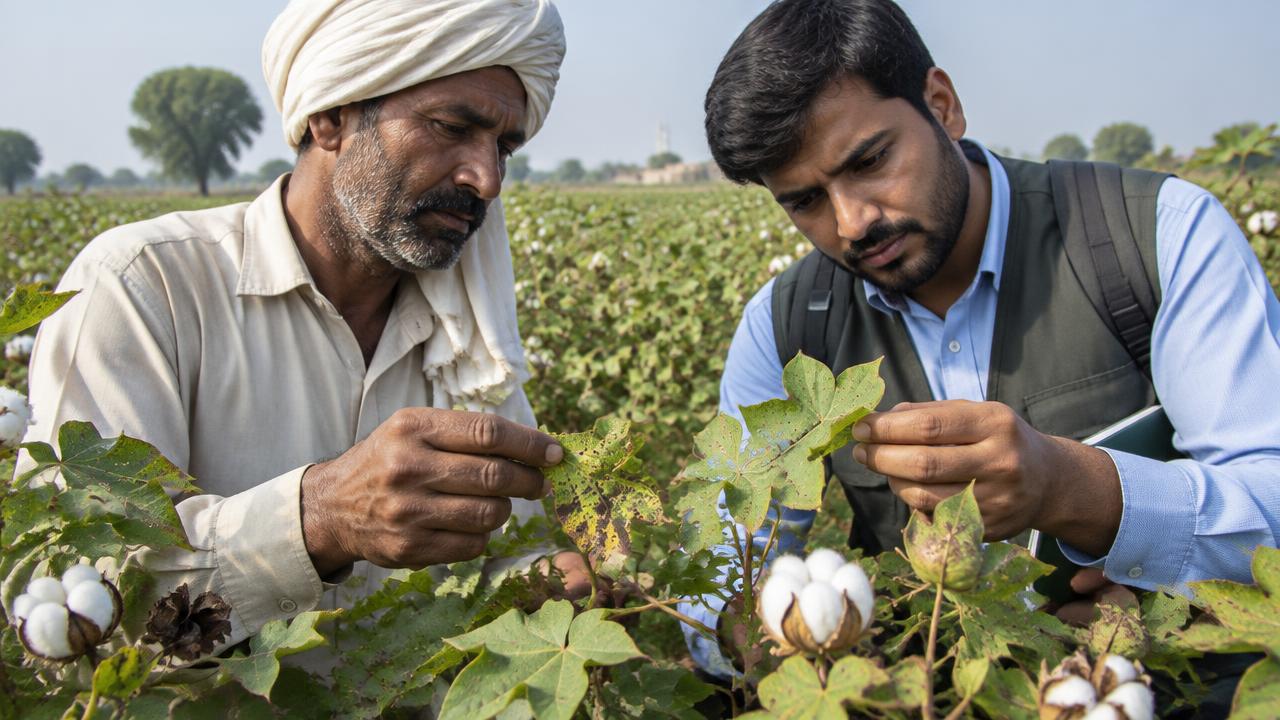
Most crop protection mistakes do not start in the sprayer. They start earlier, when a product is chosen from memory, from a neighbour's field or from a shop shelf, without first confirming what is actually damaging the crop.
This guide walks through the decision in the order a careful buyer should take it: look at the crop, name the problem, match it to a product category and formulation, read the label, and only then ask for a price. It is written for growers, dealers and business buyers in Punjab and the rest of Pakistan, where the same field can move from cotton in Kharif to wheat in Rabi within a few weeks.
Step 1: Describe the problem before naming a product
A crop protection product is only correct in relation to a specific problem, on a specific crop, at a specific stage. Before anything else, write down five things: the crop, its growth stage, what you are seeing, where on the plant you are seeing it, and how widely it has spread across the field.
Symptoms are easy to confuse. Yellowing on cotton leaves can come from sucking pests, from a nutrient shortage, from waterlogging after heavy irrigation, or from root damage. Patchy wilting in a rice field can be insect damage at the base of the tiller or it can be a water and soil problem. Spraying an insecticide on a nutritional problem costs money and solves nothing, and it also delays the correct action by a week or more.
Where the cause is not obvious, take clear photographs of the affected plant, the damaged part and the general field view, and keep a few affected plants intact. A photograph of a chewed leaf, a rolled leaf, a bored stem or a discoloured root tells far more than the phrase "my crop is damaged".
- Crop and variety, and whether it is a Kharif or Rabi planting.
- Growth stage: seedling, tillering, flowering, boll or grain formation.
- Visible symptom: chewing, sucking marks, leaf spots, wilting, weeds.
- Position: upper leaves, lower leaves, stem, root zone, whole plant.
- Spread: a few plants, patches, or the whole field.
Step 2: Match the problem to the right product category
Crop protection products are grouped by the kind of organism they act on. Insecticides are for insect pests, fungicides for fungal diseases, herbicides for weeds, acaricides for mites and rodenticides for rodents. These categories are not interchangeable, and a product outside the right category will not work no matter how much is applied.
Common insect problems in Pakistani field crops
Cotton growers deal with sucking pests such as whitefly, jassid and thrips in the early and mid season, and with bollworm complexes later. Rice growers watch for stem borers, whose damage shows as dead hearts in the vegetative stage and white ears at heading, and for plant hoppers at the base of the crop. Wheat commonly faces aphids in the cooler months, and sugarcane faces stem and top borers.
Identifying the pest group matters because the same crop can host very different insects in the same month, and products differ in which insects appear on their approved label.
Common disease and weed problems
Fungal diseases usually show as spots, blights, rots, powdery or rusty growth. Wheat rusts, rice blast and sheath blight, and fruit and vegetable blights are widely reported disease groups in the region. Fungicides differ in whether the label supports protective use before infection or activity against an established infection, and timing is often the deciding factor in the result.
Weeds need a different decision again. Narrow-leaf weeds and broad-leaf weeds are controlled by different herbicide chemistries, and timing splits into pre-emergence and post-emergence use. A herbicide cleared for one crop can seriously damage another, so the crop name on the label must match the crop in the field.
Step 3: Understand the formulation, not just the name
Two products can share an active ingredient and still behave differently in the tank because the formulation is different. Labels use short codes: EC for emulsifiable concentrate, SC for suspension concentrate, WP for wettable powder, WG for water dispersible granule, OD for oil dispersion, EW for emulsion in water, and G or GR for granules applied directly to soil.
The formulation affects how the product is measured, how it must be mixed, whether it needs continuous agitation, whether it suits a knapsack sprayer or a boom sprayer, and how it should be stored in summer heat. Powder formulations behave differently in hard or muddy water than liquid ones, and granules are applied to soil rather than sprayed.
When you request a quotation, state the formulation you want or ask which formulations are available. A request for "one hundred litres" is incomplete if the product is sold as a granule, and a request for a 250 ml pack is unhelpful if the pack sizes available are one litre and five litres.
Step 4: Read the label as the final authority
The registered product label is the legal and technical authority for use. Nothing on this website, in a shop conversation or in a WhatsApp message overrides it. The label states the approved crops, the target pests or diseases, the approved dose, the application method, the pre-harvest interval, the re-entry precautions, the protective equipment required, the storage conditions and first-aid guidance.
Read the label before purchase, not after opening the container. If the label does not name your crop or your target problem, that product is not the right choice for that situation, even if it is widely used nearby. If the label is missing, damaged or unreadable, ask for documentation before handling the product.
The pre-harvest interval deserves particular attention for vegetables, fruit and fodder crops. Harvesting too soon after an application can leave residues above acceptable limits, which is a food safety and a market access problem, not only a compliance one.
Step 5: Plan for resistance and rotation
Using the same chemistry repeatedly, season after season, on the same pest population increases the risk that the pest stops responding. Resistance is a well-documented problem in sucking pests and in some weed populations, and once it develops it cannot be reversed by increasing the dose.
Practical steps are rotation between different modes of action across a season, correct dosing rather than under-dosing, good spray coverage, and combining chemical control with other measures such as field sanitation, resistant varieties, timely sowing and monitoring. Correct dose and correct timing protect the usefulness of the chemistry as well as the crop.
Step 6: Turn the decision into a clear inquiry
Once the problem and the product category are clear, the buying conversation becomes short. A complete inquiry avoids two or three rounds of questions and lets the supplier confirm exactly what can be supplied.
Rosechem Life Science supplies crop protection chemicals, plant nutrition products, soil health products and industrial chemical solutions from Lahore, and works through inquiries rather than online checkout. You can browse the categories on the products page and send the details through the contact form.
- Product name, and active ingredient and formulation if known.
- Crop, growth stage and the problem you are targeting.
- Quantity required and preferred pack size.
- Delivery location and the timing you are working to.
- Any documentation you need, such as the label or safety data sheet.
Frequently asked questions
What information should I send when asking about a crop protection product?
Send the crop, growth stage, the pest, disease or weed you are seeing, the product name and formulation if you know them, the quantity and pack size required, your delivery location and any documents you need.
Can a website page replace the product label?
No. The registered label and the safety data sheet are the authority for approved crops, doses, timing, protective equipment, pre-harvest intervals and storage. Website pages help you identify a product and start a conversation.
My neighbour used a product successfully. Can I use the same one?
Only if the crop, the target problem and the growth stage match, and the label supports that use. Fields differ in pest pressure, variety, irrigation and soil, so the same product is not automatically the right choice.
Is a higher dose more effective?
No. Doses above the label rate raise cost, residue and safety risks without a guaranteed benefit, and they do not solve a wrong product choice. Follow the dose printed on the registered label.
How do I avoid resistance problems?
Rotate between different modes of action, apply the correct label dose at the correct time, get good spray coverage, and combine chemical control with monitoring and cultural practices.
Further reading and sources
These independent organisations publish guidance on pesticide management, plant nutrition and chemical safety. They are useful background reading alongside the product label and safety data sheet.
Article author
Anwar Hussain
Anwar Hussain is the owner and key contact of Rosechem Life Science, a chemical supply company based at 16 Km Multan Road, Pakka Meel Stop, Shah Pur, Lahore, which supplies crop protection chemicals, plant nutrition products, soil health products and industrial chemical solutions. Articles draw on product documentation and publicly available agricultural guidance, and give general information only. They do not replace the product label, the safety data sheet or advice from a suitably qualified professional for a specific field or process.