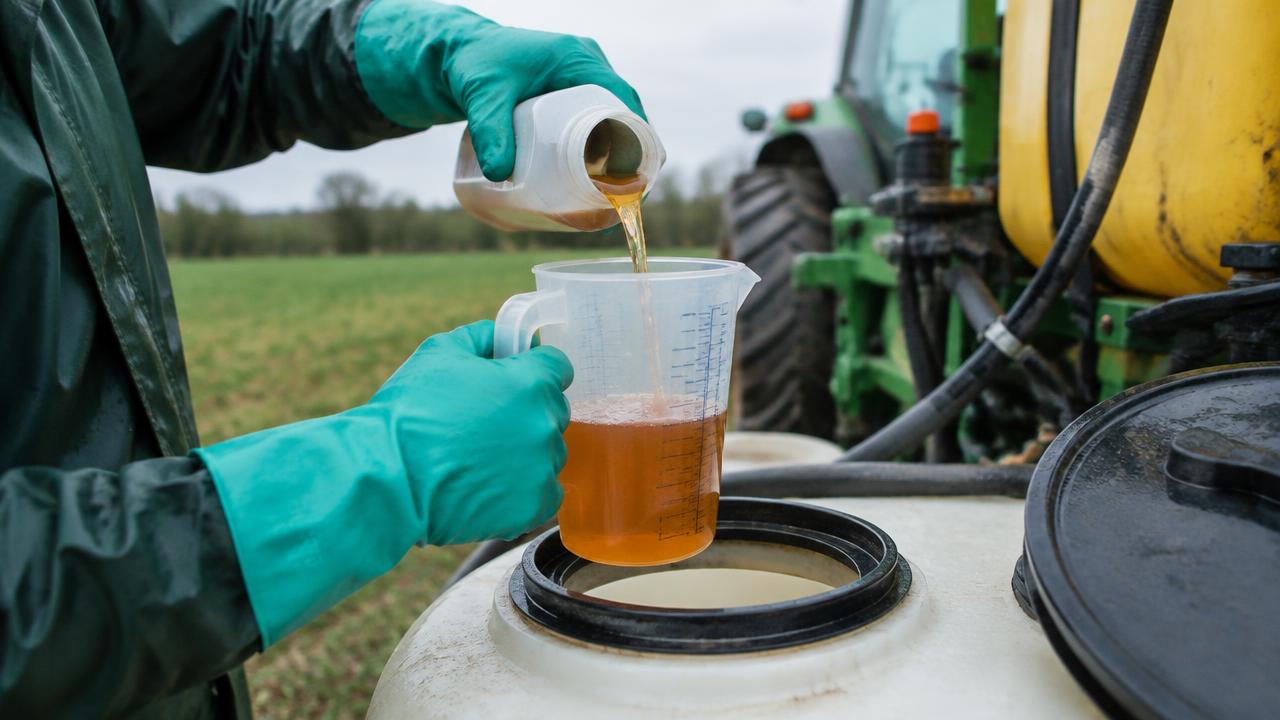
Two containers can carry the same active ingredient at the same strength and still behave completely differently in a tank. The reason is formulation: the way the active ingredient is prepared, carried and released.
Formulation decides how a product is measured, whether it needs agitation, how it responds to hard water, which equipment suits it and how it should be stored through a Punjab summer. This article explains the common codes and what each one means at the tank.
What the formulation codes mean
Formulation codes are printed on the label next to the concentration, and each describes a physical form rather than a strength.
- EC — emulsifiable concentrate: an oil-based liquid that forms a milky emulsion in water. Easy to measure; solvents mean careful handling and skin protection.
- SC — suspension concentrate: fine solid particles suspended in water. Low odour and gentle on equipment; needs shaking before use and agitation in the tank.
- WP — wettable powder: a powder that disperses in water. Cost-effective, but dusty when poured and prone to settling without agitation.
- WG or WDG — water dispersible granule: granules that break apart in water. Less dust than a WP and easier to measure.
- OD — oil dispersion: solid particles suspended in oil, often chosen to improve uptake on waxy leaf surfaces.
- EW — emulsion in water: an oil-in-water emulsion with less solvent than an EC.
- SL — soluble liquid: dissolves completely, leaving a true solution.
- G or GR — granules applied directly to soil or water, not sprayed.
- FS — flowable concentrate for seed treatment, used to coat seed rather than spray a crop.
How formulation changes the mixing routine
Mixing order is not arbitrary. A widely used sequence is to half-fill the tank with clean water, start agitation, then add products in order of formulation: water dispersible granules and wettable powders first, then suspension concentrates, then emulsifiable concentrates and other liquids, then soluble liquids and finally adjuvants, topping up with water at the end.
Powders and granules should be pre-mixed into a slurry in a bucket before entering the tank, so they disperse instead of sinking as lumps. Suspension concentrates need the container shaken thoroughly first, because settling during storage is normal.
Agitation must continue while spraying, not only while filling. Suspensions and powders separate quickly when a sprayer stands still during a break, which leads to weak coverage at the start and an over-concentrated tank at the end.
Water quality, temperature and tank behaviour
Spray water is an ingredient, not just a carrier. Hard water high in calcium and magnesium can reduce the performance of some chemistries; high pH water can break down certain actives in the tank within hours, which is why the label sometimes advises spraying soon after mixing rather than leaving a filled tank overnight.
Dirty or silty water clogs filters and nozzles and can reduce the effectiveness of suspension products. Filtering the water and cleaning the sprayer filters is a small job that prevents an uneven application.
Heat matters in storage as well as in use. Emulsifiable concentrates and suspension products both have temperature limits printed on the label, and repeated exposure to extreme heat or to freezing can permanently change how a product mixes.
A simple compatibility check
Before mixing two products for the first time, scale the intended rates down into a clear jar of the same water you will actually use, in the same order. Shake it, then leave it for fifteen to thirty minutes.
Separation into layers, curdling, clumping, gelling or heavy sediment means the mixture is not compatible at that concentration. It is far better to discover that in a jar than in a full tank in the middle of a field.
Equipment, nozzles and coverage
Coverage decides results for contact products. Nozzle type, spray pressure, boom or lance height and walking speed together determine droplet size and how evenly the spray lands. Very fine droplets drift easily in wind; very coarse droplets give poor coverage of small targets.
Calibration is the step most often skipped. Measuring how much the sprayer actually delivers over a known area tells you whether you are applying the label rate or half of it, and it takes only a few minutes with water. An uncalibrated sprayer makes every dose calculation theoretical.
Nozzles wear out. A worn nozzle delivers more liquid than its rating, so output gradually rises while the operator assumes nothing has changed. Checking and replacing nozzles is cheaper than a season of over-application.
Why formulation belongs in your inquiry
Because formulation affects handling, equipment and storage, it should appear in a quotation request alongside the product name. A buyer who needs a suspension concentrate for a drip or low-drift setup should not receive a wettable powder by default, and a buyer needing soil granules cannot use a sprayable liquid.
Rosechem Life Science lists formulation details on product pages where they are verified, and the contact form can be used to request the label or safety data sheet before deciding.
Frequently asked questions
What does formulation mean on a chemical label?
It describes the physical form and preparation of the product — EC, SC, WP, WG, OD, EW, SL, granule or seed treatment — which determines how it is measured, mixed, applied and stored.
In what order should products be added to the tank?
A common order is water dispersible granules and wettable powders first, then suspension concentrates, then emulsifiable concentrates and liquids, then soluble liquids and adjuvants last, with the tank half full and agitation running.
Does water quality really affect a spray?
Yes. Hardness, pH and silt can reduce effectiveness, break down some actives and block filters and nozzles. Use clean, filtered water and follow any label guidance on water conditions.
How do I know two products can be mixed?
Check both labels first. Where a mix is permitted but untested for your conditions, run a small jar test at the same rates and in the same water and watch for separation, clumping or sediment.
Why does sprayer calibration matter?
Without calibration you cannot know how much product is actually applied per unit area, so the label dose becomes guesswork and worn nozzles quietly increase output over time.
Further reading and sources
These independent organisations publish guidance on pesticide management, plant nutrition and chemical safety. They are useful background reading alongside the product label and safety data sheet.

Article author
Anwar Hussain
Anwar Hussain is the owner and key contact of Rosechem Life Science, a chemical supply company based at 16 Km Multan Road, Pakka Meel Stop, Shah Pur, Lahore, which supplies crop protection chemicals, plant nutrition products, soil health products and industrial chemical solutions. Articles draw on product documentation and publicly available agricultural guidance, and give general information only. They do not replace the product label, the safety data sheet or advice from a suitably qualified professional for a specific field or process.