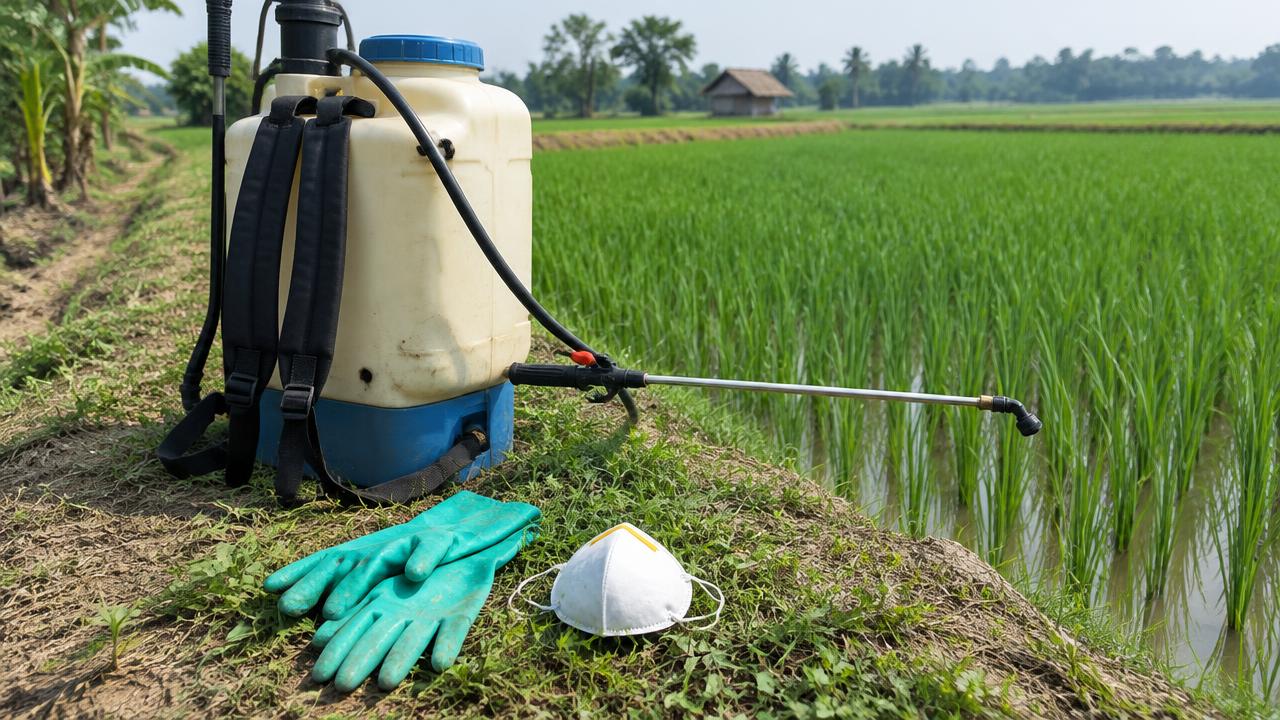
"Pesticide" is a general word. Under it sit several product families that are designed for completely different organisms and used at completely different moments in the crop calendar.
Buying the wrong family is one of the most expensive mistakes in a season, because the product is paid for, applied, and then the original problem continues to grow. This article explains what each category does, how the timing differs, and how to tell which one your field actually needs.
Insecticides: products for insect pests
Insecticides act on insects. They are grouped by how they reach the pest and by how they act inside it. Contact products need to touch the insect or the treated surface. Systemic products move within the plant, which can help against sucking pests hidden on the underside of leaves. Stomach-acting products work when the pest feeds on treated tissue.
In Pakistani field crops the insect problems change with the season. Kharif cotton typically faces sucking pests such as whitefly, jassid and thrips early on and bollworm complexes later. Rice faces stem borers and plant hoppers. Rabi wheat commonly sees aphids as temperatures rise late in the season, and sugarcane faces borer complexes over a long crop cycle.
Because insect life stages matter, timing is part of the product decision. Some products are directed at larvae, some at adults, and label directions often reference a scouting threshold or a crop stage rather than a fixed calendar date.
Scouting before spraying
Walking the field and counting pests on a set number of plants gives a far better basis for a decision than a glance from the boundary. Economic thresholds published by agricultural extension services exist so that a spray is applied when the damage justifies it, not before.
Scouting also reveals beneficial insects. Predators and parasitoids suppress pest numbers at no cost, and broad-spectrum sprays applied too early can remove them and make later pest flare-ups worse.
Fungicides: products for fungal disease
Fungicides act on fungal pathogens. Many are protectant products that must be present on the plant surface before infection occurs; others have systemic movement and label support for use after infection has begun. The distinction is important, because a protectant applied after a disease is established will usually disappoint.
Disease develops when a susceptible crop, a present pathogen and favourable weather come together. Extended leaf wetness, high humidity, dense canopies and irrigation timing all influence risk. Wheat rusts, rice blast and sheath blight, and blights in vegetables are widely reported disease groups in South Asia, and each has its own favourable conditions.
This is why disease management is usually planned as a programme rather than as a single reaction. Variety selection, sowing date, seed treatment, field sanitation, canopy management and correctly timed applications all contribute, and the label states which diseases and crops the product is approved for.
Herbicides: products for weed control
Herbicides act on plants, which makes crop safety the central question. A selective herbicide is designed to control certain weeds while leaving the named crop unharmed; a non-selective herbicide affects most green plants it contacts. Using a selective product on a crop that is not on the label can cause serious injury.
Timing is expressed as pre-emergence, applied before weeds or crop emerge, and post-emergence, applied to emerged weeds at a stated leaf stage. Post-emergence products generally work best on small, actively growing weeds; large weeds are harder to control and often need a return to cultural methods.
Weeds also split into narrow-leaf grasses and broad-leaf types, and many herbicides are strong on one group and weak on the other. Wheat growers in the region frequently deal with grassy weeds alongside broad-leaf weeds in the same field, which is why the weed spectrum on the label matters as much as the crop name.
- Check the crop name on the label, not just the weed name.
- Check the weed stage the label specifies.
- Check any restriction on the next crop in the rotation.
- Clean the sprayer thoroughly before switching between herbicides and other products.
Side-by-side: how the three categories compare
Insecticides target insects and are usually decided by scouting and thresholds. Fungicides target fungal pathogens and are usually decided by weather risk and crop stage, often before symptoms are severe. Herbicides target weeds and are decided by weed species, weed stage and crop tolerance.
One practical consequence: an insecticide will not stop a leaf spot, a fungicide will not stop a borer, and neither will stop a weed. When the diagnosis is uncertain, spending an extra day on identification is cheaper than spending on the wrong product.
Tank mixing and sprayer hygiene
Mixing products in one tank is common, but not every combination is compatible, and not every label permits it. Incompatible mixes can block nozzles, separate in the tank, reduce effectiveness or injure the crop. Where a mix is not covered by the label, the safe route is to apply separately or to test a small volume first.
Sprayer hygiene matters most with herbicides. Residues left in a tank, hose or nozzle can damage a sensitive crop sprayed afterwards, even at very small concentrations. Rinse according to the label instructions and keep a separate sprayer for herbicides where possible.
What to confirm before you order
Once you know which category the field needs, the ordering questions are the same across all three. Rosechem Life Science lists crop protection and plant nutrition categories on the products page and works through written inquiries, so the details below make the reply faster and more accurate.
- Category and product name, with active ingredient and formulation if known.
- Crop, growth stage and the target pest, disease or weed.
- Quantity and pack size, and whether the requirement repeats through the season.
- Delivery location and timing.
Frequently asked questions
Can one product control insects, disease and weeds together?
No. The three categories act on different organisms. A product controls only what appears on its approved label, and the target must be identified before a product is selected.
What is the difference between a contact and a systemic product?
A contact product acts where it lands and needs good coverage. A systemic product moves inside the plant, which can help against pests or pathogens that are hidden from the spray.
Why is herbicide timing described as pre-emergence or post-emergence?
Pre-emergence products are applied before weeds emerge and act on germinating weeds; post-emergence products are applied to weeds that have already emerged at a stated leaf stage. Using one at the other's timing usually fails.
Do I need to clean the sprayer between products?
Yes. Residues, especially herbicide residues, can damage the next crop sprayed. Follow the cleaning instructions on the label and keep a separate herbicide sprayer where you can.
Further reading and sources
These independent organisations publish guidance on pesticide management, plant nutrition and chemical safety. They are useful background reading alongside the product label and safety data sheet.
Article author
Anwar Hussain
Anwar Hussain is the owner and key contact of Rosechem Life Science, a chemical supply company based at 16 Km Multan Road, Pakka Meel Stop, Shah Pur, Lahore, which supplies crop protection chemicals, plant nutrition products, soil health products and industrial chemical solutions. Articles draw on product documentation and publicly available agricultural guidance, and give general information only. They do not replace the product label, the safety data sheet or advice from a suitably qualified professional for a specific field or process.