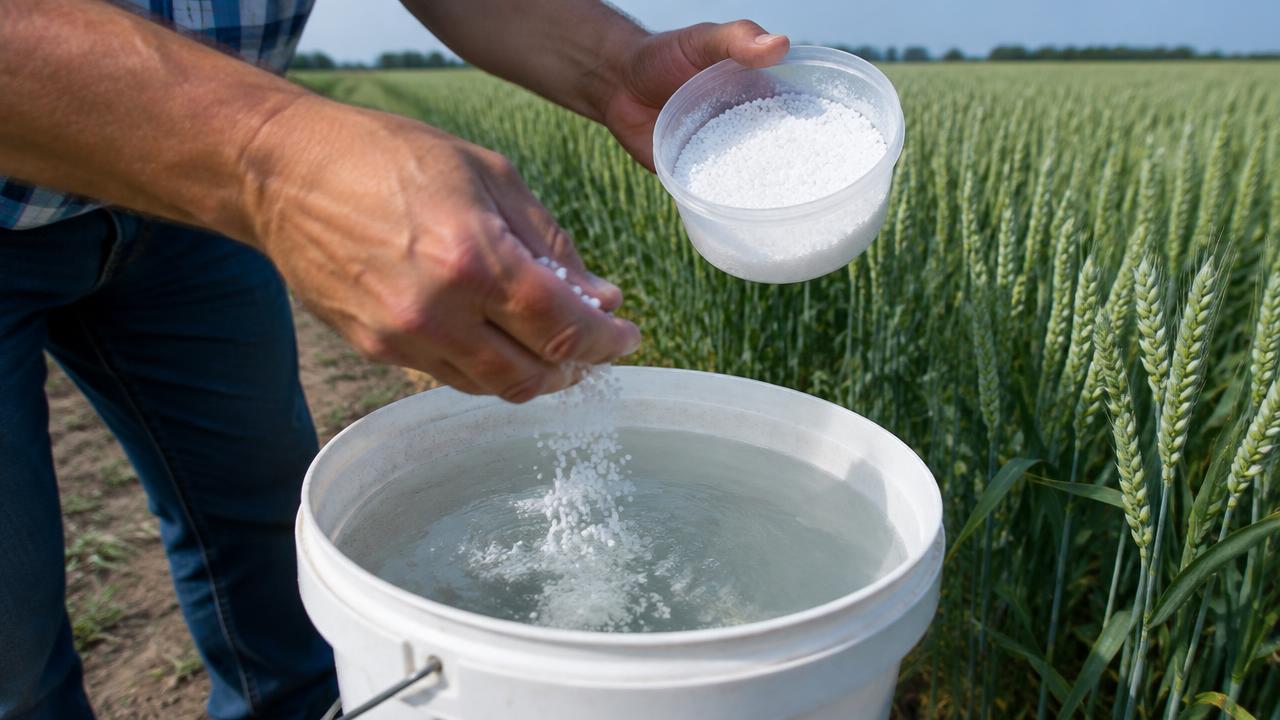
Fertilizer buying looks simple until you compare two bags with different numbers, different pack sizes and different prices, and have to decide which one actually delivers more nutrient to the crop.
This guide explains what the numbers on a fertilizer label mean, how product forms differ, why micronutrient chemistry matters in high-pH soils, and what to include in an inquiry so that you are comparing like with like.
Reading the grade: what 12-61-0 actually means
Most compound fertilizers show three numbers in a fixed order: nitrogen (N), phosphorus expressed as P2O5, and potassium expressed as K2O. A grade of 12-61-0 means the product declares twelve per cent nitrogen, sixty-one per cent phosphorus as P2O5 and no potassium. A grade of 0-0-50 is a potassium product with no nitrogen or phosphorus.
Because the numbers are percentages by weight, they let you compare products on nutrient content rather than bag weight. Twenty-five kilograms of a 20-20-20 product supplies five kilograms of nitrogen; twenty-five kilograms of a 10-10-10 product supplies half that. Comparing two quotations only makes sense after converting price to price per unit of nutrient.
Grades do not tell you everything. Two products with the same grade can differ in solubility, purity, chloride content, particle size and the chemical form of each nutrient, all of which affect how the product behaves in a tank or in the soil.
Nutrient forms and why they matter
Nitrogen appears in urea, ammonium and nitrate forms. They behave differently: urea must convert before the plant can use it and can lose nitrogen to the air if left on a hot, dry surface; nitrate is immediately available and moves easily with water, which also means it can be lost from sandy soils under heavy irrigation.
Phosphorus availability is strongly influenced by soil pH. In the alkaline, calcareous soils common across much of Punjab and Sindh, applied phosphorus can be fixed into forms the crop cannot readily take up, which is why placement and timing matter as much as quantity.
Potassium is supplied mainly as sulphate or chloride forms. The sulphate form is generally preferred where a crop is sensitive to chloride or where soil salinity is already a concern.
Water-soluble, granular and liquid products
Water-soluble fertilizers are designed to dissolve fully and are used through drip and sprinkler systems or as foliar sprays. Their advantages are precise timing and even distribution; their requirements are good water quality, correct dissolving order and clean filters.
Granular products are broadcast or placed in the soil and release nutrients over a longer period. They suit base dressing and bulk field nutrition, and they need soil moisture to become available.
Liquid and suspension products save mixing time and suit certain injection systems, but they have their own storage considerations, including temperature limits and settling during long storage.
Water quality in fertigation
Hard water with high calcium and magnesium can react with phosphates and sulphates and form precipitates that block drip emitters. Where water is hard or high in bicarbonates, dissolving order and compatibility become practical issues rather than theoretical ones.
A simple jar test with the actual irrigation water, at the intended concentration, shows in a few minutes whether a mixture stays clear or turns cloudy. It costs nothing and prevents a blocked system during peak demand.
Micronutrients: small quantities, precise chemistry
Zinc, boron, iron, manganese and copper are required in small amounts, but deficiencies are common and visible. Zinc deficiency is widely reported in rice and in other crops grown on alkaline soils, and boron deficiency affects flowering and fruit set in several crops.
The chemical form decides whether the nutrient stays available. Sulphate forms are common and economical. Chelated forms, such as EDTA chelates, keep the nutrient protected from reactions in high-pH soils and water, which is often the reason they are chosen despite a higher price per kilogram.
Micronutrients also have a narrower safe range than major nutrients. Boron in particular can move from deficient to toxic across a fairly small dose range, so label rates should be followed exactly rather than rounded up.
Soil testing and the limits of a product label
A fertilizer product supplies nutrients; it does not diagnose what the crop is short of. Soil testing for organic matter, pH, electrical conductivity and available nutrients turns a guess into a plan, and it is especially useful where salinity or sodicity is suspected.
Crop removal also matters. A high-yielding wheat or maize crop removes more nutrient than a low-yielding one, and a nutrition plan that never changes across years will drift out of balance. Where a qualified agronomist or a public extension service is available, a soil report read together with the crop plan is the most reliable basis for buying.
Product pages and grades help identify what to buy. They are not a recommendation for a given field, and no plant nutrition product guarantees a yield result on its own.
What to include in a plant nutrition inquiry
Nutrition products are ordered by grade and form, so an inquiry that states both is answered quickly. Rosechem Life Science supplies water-soluble fertilizers, micronutrients, soil conditioners and biostimulants alongside crop protection products, and handles requirements through the contact form.
- The grade you need, for example 20-20-20, 12-61-0 or 0-0-50.
- Product form: water-soluble powder, granule, liquid or chelated micronutrient.
- Application system: drip, sprinkler, foliar spray or soil application.
- Pack size and total quantity, and whether the need repeats each season.
- Delivery location and required timing.
Frequently asked questions
What do the three numbers on a fertilizer bag mean?
They are the declared percentages of nitrogen, phosphorus as P2O5 and potassium as K2O, always in that order. They let you compare products by nutrient content rather than by bag weight.
Is a chelated micronutrient worth the extra cost?
It depends on your soil and water. In alkaline, high-pH conditions a chelated form keeps the nutrient available where a simple sulphate form may become locked up, which can justify the price difference.
Can I mix any two water-soluble fertilizers in one tank?
No. Some combinations, particularly calcium with phosphates or sulphates, form precipitates that block emitters. Check compatibility guidance and run a jar test with your own irrigation water first.
Do I need a soil test before ordering fertilizer?
A soil test is the most reliable way to decide what your field is short of. Without one, a nutrition plan is based on assumption, and imbalances build up over successive seasons.
Will a fertilizer product guarantee a higher yield?
No. Nutrition is one factor among variety, water, soil condition, pest and disease pressure and timing. Any product page describes the product, not a guaranteed result.
Further reading and sources
These independent organisations publish guidance on pesticide management, plant nutrition and chemical safety. They are useful background reading alongside the product label and safety data sheet.

Article author
Anwar Hussain
Anwar Hussain is the owner and key contact of Rosechem Life Science, a chemical supply company based at 16 Km Multan Road, Pakka Meel Stop, Shah Pur, Lahore, which supplies crop protection chemicals, plant nutrition products, soil health products and industrial chemical solutions. Articles draw on product documentation and publicly available agricultural guidance, and give general information only. They do not replace the product label, the safety data sheet or advice from a suitably qualified professional for a specific field or process.